Saturday, September 17, 2011

A shrine surprise.

My visit to the Harajuku district of Tokyo wasn't just about the craziness of Takeshita street.  We did some official sight seeing as well with a stop to the famed Meiji Shrine. This grand structure was dedicated to Meiji Emperor and his consort Shoken.  Here's the interesting part; it was completed in 1920.  But destroyed in an air raid in 1945.  World War II was hard on the landmarks of Japan.  However I'm told the reconstructed structure is identical to the original.

This brings up an interesting observation about Japan.  From war, to fire, to earthquakes, to tsunamis, Japan is a country that is constantly being destroyed.  So there are very few structures that are more than a century old.  That means that even though the country feels steeped in ancient traditions, the reality is that it's a country that lives in the now, constantly rebuilding. It's another example of the tension that is Japan: a desire to honor long-held tradition in a place where everything is new, or at least not old.

But that's not what we're here to discuss.  We're here to talk about the Meiji Shrine.  Here I am at the front gate.  And what a front gate?  I love these huge Japanese entrances.

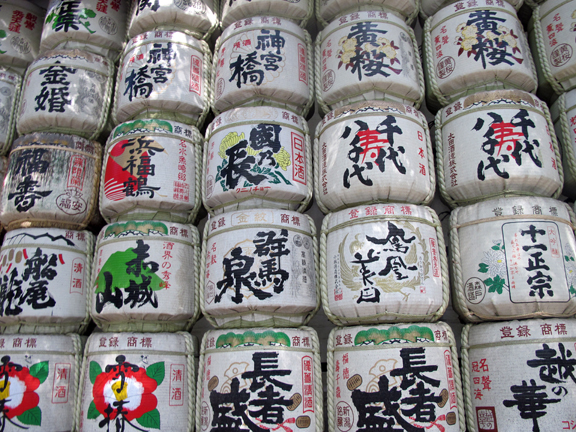
The Meiji Shrine offers plenty of details to catch your attention, some subtle, some grand.


While we were in the main area of the shrine, a surprise procession entered with a fair bit of drama.  I think it might have been a wedding as my guide book said that traditional, Shinto-style weddings are common.

 
Our visit was cut short (you can ask Felix about that), so we didn't get to explore much more.  But even a brief visit to the Meiji Shrines gives you plenty of respect for the grandeur of Japan.

Thursday, September 15, 2011

Yes Virginia, there really is an international museum of manga.

So I'm reading up on Kyoto and come across a listing for the Kyoto International Manga Museum.  Exactly! How can you not pay a visit to anything named the Kyoto International Manga Museum?  So we climbed on our bikes (more on that later), and peddaled our way to the museum.

I'll admit it, I'm not a big manga aficionado.  And I didn't really know what to expect at this museum.  It was different than I could have ever imagined. It's basically a repository for every Japanese manga book ever created since about 1940.  There are stacks and stacks of manga books and you can browse to your heart's content.  One floor features manga for young children.  Another features manga for girls.  And still another features manga for boys.


Of course, if you have trouble finding exactly what you're looking for, the museum staff is happy to help.  One of the best museum cards I've ever seen is this:


Every where you went there were people pulling favorite manga books from the shelves and reading.

There were also exhibits that discussed the history of manga or even how it was made.

One of the funniest things about the museum is that is was crawling with television reporters.  I've been watching crazy Japanese television since I arrived in the country.  And for the first time, I got to see crazy Japanese television made.  Here's a video:

I absolutely fell in love with the massive bank of manga vending machines.

I bought a few things from the vending machines.  And a few things from the gift shop.  Most of which may be headed for my favorite manga fans, my nieces. 

I loved the Kyoto International Manga Museum and if I'm ever in the area again, I'll be sure to retun.

This is REAL hotel service: Luggage transfer.

The staff and porters at the Yuzuya ryokan were unbelievably attentive.  And one of the services they offered was luggage transfer.  For a reasonable fee, they would handle transferring all your luggage from Yuzuya to our next hotel, The Screen. My response, "sign me up."  Rather than lug our luggage to the hotel, have them hold it for us until check in time, we went sight seeing.  And then late in the afternoon we checked in at The Screen where our luggage was waiting in our room, each piece carefully tagged by the Yuzuya staff and addressed personally to Mr. Jeffrey.

Heads up friends back home: I've decided that from here on out, I might want to be referred to as Mr. Jeffrey.

Japanese breakfast: English for weird food.

When we checked into the Yuzuya ryokan, they carefully scheduled our dinner and then asked if we wanted the Japanese or continental breakfast.  We chose Japanese to get the full ryokan experience.  Here's the translation of that request.

The first plate was this:
On the right is a bowl of rice covered with a sticky, gooey substance called grated taro.  With your rice you could enjoy all kinds of little samplings.  I'll try and remember what they were starting in the upper left and working my way across and down the grid.  First was baby eel with chopped peppers.  After the previous night's eel, I was terrified to taste this dish.  But I actually liked it.

Next was a bowl of tiny shell fish in a salty sauce.  It was delicious.  Then there was a sweet potato that was delicious.  Next bowl, I don't remember what it was but there were pickles and I like the Japanese pickles. 

Next was shaved soba and some sort of vegetable.  It was pretty good.  Then there was "deep-fried" tofu.  I don't know how they deep fry things in Japan but it's completely different that they way we do it in the US.  Once again, "deep fried" meant soggy.

The bottom row starts with pickled tiny cucumbers.  I could eat these all day.  Then came sea weed; I didn't like this.  Finally, something else pickled.  Did I already say this, I love Japanese pickles.

Here's the second plate:


This plate featured a grilled fish (I can't remember exactly what type).  Then in the top bowl was an eggplant dish that I didn't like at all.  It was totally slimy.  Lower left is "rolled egg" with grated radish on top.  I liked this a lot although it's strange how differently eggs can be cooked.  The final dish was miso soup.  Can I just say, miso soup is so much better in Japan than it is in the US.  I normally hate it, but here it is consistently good.

A big thanks to the Yuzuya staff for creating a memorable meal.  Just as memorable as the entire stay.

The magic of the endlessly expanding, Japanese coinage.

OK, what's with the Japanese coins?  Once they start collecting in your pockets they refuse to stop.  In fact, they multiply at an alarming rate.  And believe me, I'm trying to get rid of them.  Just moments ago at the Family Mart I was so proud to use four coins to pay for my purchase.  And then, in return, I received seven coins.

Yesterday, I used what I thought was exact change for a subway ticket and received a handful of coins in return.  I have my suspicions.  I think the Japanese are playing a joke on us gaijin, secretly laughing at us as they load our pockets with massive amounts of coins, many of which are largely worthless; watching us trudge with evermore difficulty through the heat and humidity, burdened by our coinage; wondering when we'll figure out the mathematics of Japanese change; hoping that we won't catch on too soon.

Well I'm not giving up.  I'll still keep paying with coins.  Sooner or later, I intend to solve the mystery of the coin-purse bulge.

Kaiseki: Japanese for weird food.

OK, I admit it; I can get a little squeamish when it comes to weird food.  But traveling to a foreign country, I felt the need to try the local delicacies.  I knew when I signed up to stay at a Japanese inn and to enjoy the Kaiseki dinner, that things might get a little weird.  I wasn't disappointed.  Here's the story of our dinner.

First, some info about Kaiseki.  This is a style of food that is popular in the Kyoto region. Like many things in Kyoto, Kaiseki is more art form that just a culinary tradition.  It balances the taste, texture, appearance, and colors of food and focuses on fresh, seasonal, local ingredients.  It's the slow-food movement long before there was a slow food movement. 

To be honest, there was a lot of stuff in this meal that I didn't like.  But it was a great adventure that started with a delightful aperitif.  We were asked to turn over some small bowls.  Stuck to the inside of each bowl was a disk of fruit designed to represent the moon in its current phase.  Our host carefully poured rice wine into the bowl which release the fragrance of the fruit.  I have to say, it was a nice way to start a meal.

We then ordered a delicious cocktail made with Yuzu juice and some sort of alcohol.  As I mentioned in an earlier post, Yuzu is a citrus fruit that's like a mashup of lime, grapefruit, and tangerine.  It's tart and refreshing.  I could drink a lot of yuzu juice.

The appetizer was a basket of cooked vegetables designed to give thanks for a bountiful harvest.  It included baby eggplant, pumpkin, a root vegetable that looked something like a small branch, a carrot ball, and a strange potato.

Next came the sashimi course including shrimp, flat fish, eel, and octopus.  Wow, I really don't like raw eel! Actually, the raw fish just didn't do much for me.

The next course was all about grilled food.  It included a strange grilled fish that was really not to my liking.  I think I may have made a face.  But the grilled barracuda proved to be much better than I expected.  And the steak grill inside a leaf was delicious.  By favorites of the dish were some sort of grilled, salted beans and a strange, tart vegetable/fruit.

Our host introduced the next course as a "deep-fried," wheat "snack."  It's supposed to represent a dragon head with brown string-like things representing dragon whiskers and the fish at the center representing the dragon's eye.  All I know is that I was really looking forward to "deep fried!"  Imagine my disappointment when this turned out to be a cold, doughy "snack" soaked in a chilled liquid.  No one should ever use the words "deep" and "fried" to describe this dish. In fact "snack" is a stretch.

For the next course, our host just started taunting me and my food squeamishness.  This was the hot pot.  It came to the table with a dramatic flourish of sizzling steam.  When it was opened, lovely aromas escaped.  Our host explained that it had the fresh aroma of local mushrooms and crisp vegetables.  That sounded scrumptious! He explained that to start, he would serve us broth with the mushrooms and veggies so we could savor their delicious aromas.  He did that and I took a bite or two.  It was delicious.  Then he said he would add the pike eel.  Cooked eel: not a whole lot better than raw eel.  I stuck to the mushrooms and veggies as much as possible.

The last of the savory courses was one of my favorite dishes of the whole meal.  It was a rice porridge that arrived at the table in a covered, piping hot ceramic dish.  It opened with a gush of steam.  Into the hot rice mixture had been cracked two raw eggs. The eggs were stirred into the hot porridge, cooking the eggs softly.

Dessert featured a rice cake (which is really more of a floury jelly), green tea, and fresh fruit served on a bed of ice.  It was delicious.  The icy-cold fresh peach was perfect.  And the humongous grapes were the grapiest grapes I've ever had.

There were a couple of courses in this meal that I forgot to photograph.  The first was a snapper cooked in broth that I liked.  The second was an "special extra" dish featuring sea urchin which takes some getting used to.  In all, it was about ten courses.

This was without a doubt the most adventurous meal I've ever eaten.  And while I may not have liked everything I tasted, it was still one of the best dinners ever.  I'll end with photos of Felix and me at dinner.

Wednesday, September 14, 2011

A night at the Ryokan.

After plenty of research about traveling to Japan, I decided that one of the things I wanted to do was stay in a traditional Japanese inn, a ryokan.  Kyoto is known for some of the best and since I was traveling there, I thought that would be a good place for a night at the ryokan.  Based on a few internet recommendations, I chose the Yuzuya Ryokan.

It's in an incredible location, right next to a shrine (expect more on that later). For this post, not too much commentary, but plenty of photos, starting with the secret entrance.


Once you walk through the doors you find a magical, if not treachorous pathway leading to the hotel.


I don't know why but I completely forgot to take pictures of the beautiful entrance and lobby.  Maybe because we weren't there long.  We were immediately shuffled off to our room where tea service was waiting.

Tea included fresh radish, pickled in Yuzu juice.  Yuzu is a citrus fruit that tastes something like a lime, a grapefruit, and a tangerine mixed together. It's also the fruit that gives this ryokan it's name, there were even Yuzu trees in the hotel's gardens. One of the best parts about Japan: all the little pickled thingies.


The room was traditional with tatami mat floors (I wore slippers onto the mats to the horror of our host) and rice paper screens.

The hotel stationary set was particularly cool.  It looked like something left over from the 1940s.

The bath and shower area were very traditional with a small shower stool so you can wash up before climbing into a wood tub.  The whole place smelled of cedar and citrus thanks to the Yuzu fruit provided to scent your bath.

The room came with traditional Japanese bath robes.  Here's Felix trying his on.  We still don't know if we put them on right.

The whole experience of settling into our room was terrific fun.  And that was just a prelude to the Kaiseki-style meal that is included as part of our stay.  That's a story for another post.