Showing posts with label Japan. Show all posts

Sunday, November 6, 2011

The shrine next door.

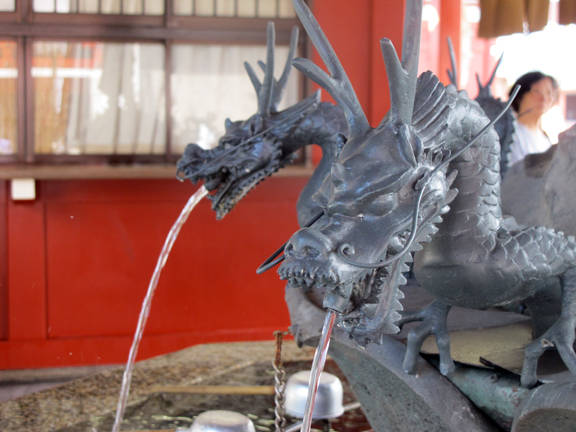
Yes it's been over a month since we returned from Japan.  But as you've noticed I'm still writing about the trip.  That's because as I catalog all of my photos and mementos from our visit to Asia, I'm realizing how many things I didn't have time to write about while I was there. So there may be a few more posts about Japan.  Posts like this noting that in Kyoto, you can't walk very far without running into a shrine.  In fact, as you stepped outside the entrance to our Ryokan, you just had to turn right and you ran into this, the Yasaka Shrine:


Monday, October 31, 2011

Missing the modern art.

While biking through Kyoto, we took a detour to the National Museum of Modern Art.  This was a museum that was surprisingly sparse when it came to art.  But maybe that's because there were no special exhibits open at the time we were there.  And while there wasn't much in the way of Art that inspired me, it did offer a couple of inspirational things including something for the bicycle fans.

First, there was this spectacular view of one of the best Japanese gates I saw on the whole trip.

But my favorite thing at the museum was a delightfully placed sculpture outside the museum.  In a brilliant bit of curating, there was a sculpture right behind the bicycle parking area.

This is Bird in Cloth Saddle, a 1974 sculpture by Makio Yamaguti.  And it does look like a bird and a bicycle saddle.


Although I'm not positive of the title.  The marker seems to read Bird in Croth Saddle and someone added the "l" later.  Is it just me, or does that seem like someone making fun of an Asian accent, "did you see that bird in a croth saddle"?

Whatever you call it, it's some fantastic Art-world whimsy.

Monday, October 24, 2011

The art of the tree

I've already expressed my profound admiration for the gardeners of Japan. But I just can't stop thinking about the endless effort that goes into creating the perfect garden vistas.  One of the most amazing signs of that effort can be found in the trees.  Everywhere we went, there were spectacular constructs used to ensure that trees could maintain the perfect shape; things that encouraged branches to hang in just the right position to frame a view; ropes and posts that when combined with trees created serendipitous archways and gates.

Rather than talk about it, why not just show you a few photographs.


Sunday, October 23, 2011

Book twenty five: Fear and Trembling by Amelie Nothomb

Continuing my quest to better understand Japanese Culture, I picked up Amelie Nothomb's short novel, Fear and Trembling.  This is the story of a smart, attractive Belgian women (also named Amelie) who has moved back to Japan and taken a job at a large Japanese enterprise, the Yumimoto Corporation.  Because she was raised in Japan her language skills are substantial.  But because she is not Japanese, it seems impossible for her to be accepted into the culture.

As she tries to make her way in the corporation, Amelie makes mistake after mistake.  But only because the demands of Japanese corporate culture are so impossible to navigate.  Soon, she's upset just about everyone including a tyrannical boss and her female Japanese supervisor.  The result? She's assigned to evermore menial and degrading office tasks.

The book's horrific tales of corporate cruelty are tempered with brilliant bits of humor. The story provides lots of interesting insight into why it's hard for foreigners to feel completely welcome in Japan, even when the entire country is so polite to outsiders.  Sometimes the madcap antics of the book cross the line into absurdity, and not always in a good way.  But Nothomb's crisp writing help make this super-short story a decent read.


Saturday, October 22, 2011

Battle of the all-star Imperial Palaces.

Is it a coincidence that Kyoto and Tokyo are comprised of the same letters?  To me it seems like it was written in the stars.  Both cities have been the capital of Japan; Kyoto in the past; Tokyo in the present.  Both boast ideologies that are quintessentially Japanese: Kyoto more traditional, Tokyo more modern.  And both have some pretty damn impressive imperial palaces.  We visited them both and here's a rundown of the two.

Kyoto's Imperial Palace requires permission from the imperial family to visit.  So be sure to get your papers before hand.  We didn't know this but lucked out as we arrived just minutes before the last English tour of the day and there were still a couple of spots available.  Although once again I didn't understand the complexities of Japanese paper work which elicited several dramatic eye rolls from our helpful Imperial Palace worker.

Kyoto's Imperial Palace offers a sense of tradition that inspires the imagination. I felt like I was in one of the epic Japanese art house movies. The palace burned down and moved repeatedly in the same general area since the 12th Century.  This latest version dates from 1855.  It was abandoned in 1869 when Japan's imperial family  moved the Edo, changed the city's name to Tokyo, and made it the capital.

If you're looking for cool, traditional Japanese architecture, this is a good place to start.  I loved the epic scale of the wide open gravel court yards and entry ways surrounded by endless lengths of building covered with amazing cypress roofs.  Yeah, I now may know more about traditional Japanese cypress roofs that you could possibly want to know.


Everywhere you looked there were interesting shapes and patterns.  The gables were amazing as were the bold graphic shapes and patterns created by painting the ends of dark beams with white paint.


As is frequently the case, some of the most interesting areas of this Japanese landmark are the gardens. It came as no surprise that this garden was built in the middle of the 19th Century.  They had an exotic romanticism that you often see in the Asian-inspired paintings of European Romanticists. They were lovely.  Our guide told us that when the royal family lived at this residence, a favorite party game was to float small boats, each with an individual glass of Sake down the garden's streams. Party goers had to write an original Japanese poem of a very specific length before the boats reached them in order to retrieve one of the drinks.  Sounds like a lot of fun.


The Tokyo Imperial Palace is currently the home of the Emperor of Japan.  It is built on the area that was previously the Edo Castle. This large park houses a number of buildings including the main residence.  As is the often the case, most of the buildings have either been destroyed in earthquakes or burnt in fires.  So most of the buildings of the Tokyo Imperial Palace are relatively new, completed in 1968.  I'm older than that.

The walk from Tokyo Station to the Palace is magical thanks to an entire forest of carefully formed pine trees.  I wouldn't have been surprised to find a Teletubby or two lurking about.


Here are photo of Felix and Me getting about as close as you can get to the Imperial Palace. Nonetheless, the view was beautiful.  And is it just me or does Felix look like some sexy movie star from the 50s? I wish I could look so chic.  Instead, I'll just have to look grumpy.


I liked how the tradition of Japan is juxtaposed with the modern city.  Every where you looked the two worlds seemed to mesh effortlessly.

I also like that this is a serious palace with massive stone walls and vast moats.  Once again, Japan's views inspired my imagination.

While much of the compound is new, many of the massive, protective gates were very old.

As always, the gardens were spectacular.


There you have it, a view of Japan's two Imperial Palaces.  I can't pick a favorite; I liked them both for different reason.  You decide which wins the Battle of the all-star Imperial Palaces.

Book twenty-four: If You Follow Me by Malena Watrous

As part of my preparation for a trip to Japan, I picked up several novels that looked to Japan for inspiration.  If You Follow Me by Malena Watrous was one of these books.  I also chose this book because it's Watrous's debut novel.  And I love reading first-time novelists.

If You Follow Me is the story of 22-year-old Marina who moves to Japan to teach English.  She and her girlfriend are both assigned to teach in a small rural town. Like any move to a strange place, the initial experience is less than fun. From the baffling rules for taking out the trash, to figuring out how to manage being a women in a male dominated culture, Marina struggles to fit in.  Her supervisor, Miyoshi tries to help by writing her letters with helpful suggestions.  But most of his notes come off critically harsh. All this fuss puts a strain on Marina's relationship with Carolyn.  So even her significant other seems to be distant.

But as the story progresses, Marina seems to settle in.  And while she continues to make culturally insensitive mistakes, she gets better at managing the situations.

If You Follow Me is solid first novel.  It's cast of quirky characters, entertaining situations, and culture-clashing humor make for a book that any world traveler would enjoy.


Tuesday, September 27, 2011

Tokyo goes traditional.

One of my favorite Tokyo site-seeing adventures was a trip to Asakusa.  This is Tokyo's working class district.  And it trends less toward skyscrapers and more toward hidden alleyways with lots of small local shops that charm and enchant.

At the heart of Asakusa is Senso-Ji, a temple which enshrines a golden statue of Kannon.  That statue was fished from the nearby Sumida river by two fisherman in 628 AD.  Although most of the structure isn't that old.  One thing you learn about Japan is that just about everything has been rebuilt thanks to fires and earthquakes continually destroying things.

I'd heard this shrine can be unpleasant due to the huge crowds.  But we got there early on a Monday morning and it was sparsely attended, mostly by the locals going about their daily routine.  Many of the shops hadn't even opened.  So I found it delightfully peaceful.

Here are a few photos:


I particularly like the two girls in this photo on their way to school.  They're dressed in adorable uniforms.  That's half the fun of Japan, seeing all the different school uniforms.

Here are few of the other sights at Senso-Ji:


For 200 Yen, you could shake a wooden box and release a metal rod on which was written a number in Japanese characters.  By matching that number with the same number of one of these wooden drawers you could find your fortune.


My fortune was surprisingly reassuring: "No. 33 REGULAR FORTUNE; When spring comes, withered tree blooms so charming. The sweet smell fills in the wood field and the sky. Your fortune will go developing your chance. The bright moon comes to shine among the fading clouds. Meeting a person of high social status, his help will bring you a happy."

"*Your request will be granted. *The patient get well soon. *The lost article will be found. *The person you wait for will come. *Building a new house and removal are both well. *Marriage and employment are both well. *To start a trip is well."

I don't know about you, but I'm for anyone or anything that will "bring me a happy." And thank god that building a new house and removal are both well!

Felix, who was having a couple of rough days in Japan, didn't fare so well with his fortune.  So he just kept trying until he got something more positive.  Maybe he'll include the contents of his multiple fortunes in the comments of this post.

There's a delightful shopping street that leads to the shrine.  We spent a few moments here browsing the touristy trinkets and Japanese snacks.

There was also an amazing little bakery where we stopped for breakfast.  I was just getting ready to make a photo essay of the shop when our visit was cut short.  You can ask Felix about that.  But I did take one photo of the delicious baked goods in production.