Showing posts with label SXSW. Show all posts

Saturday, May 7, 2011

Trend four of five technology trends SXSW 2011.

This is a continuation of my take on five technology trends that emerged from the 2011 South by Southwest Interactive Conference.  You can view all of the trends here.


4. Social media: It’s not just for hipsters.
Businesses more and more are using social media to solve real business challenges, respond to core needs, and even improve profitability.  For all those businesses out there who think that social media is a youthful fad that has nothing to do with the bottom line, you may want to think again.  In one session, Chelsea Marti with TurboTax said that during this tax season they had 80 people (double the number from last year) dedicated to managing their Twitter feed and answering incoming questions from customers.  And 68% of people who asked questions got what they needed to resolve their question.  That's got to be a lot more  affordable than staffing a call center.

Umberto Milletti from InsideView helps corporate sales professionals utilize social media to boost sales.  He notes that sales people can often learn more about prospects through social media than they can in person, helping sales people sell in a more personal way.

There were also companies making a play to be the next big thing to come out of SXSW.  This year, one company that seemed to be leading the way was GroupMe, an app designed to make it easier to send group text messages.  I heard a couple of people that said their company teams at SXSW were using the app to more easily communicate to the entire group.  I downloaded the app to my phone in exchange for a free grilled sandwich. (Yes those crazy event promotions really do work and I even got interviewed by a reporter from Ad Age while I was standing in line.) I can see how GroupMe could prove useful in both personal and business settings.

Thursday, May 5, 2011

Trend three of five technology trends from SXSW 2011.

This is a continuation of my take on five technology trends that emerged from the 2011 South by Southwest Interactive Conference.  You can view all of the trends here.


3. Life's a game. And so is business, and education, and just about everything else.
Game mechanics. Game theory. Game architecture. Call it what you like, everyone was talking about adding game like functionality to businesses, applications, or web experiences.  And most claimed that this could make everything more successful, from social media, to business processes, to solving the nation's education ailments. I may not agree with the all the hype.  But the discussion did convince me that there is something to this idea that we as humans are hardwired to respond to challenges.  And that getting recognition for solving those challenges is very rewarding.  Why not make filling out your time sheets a game, if that would help make the task less painful?


Who was touting the gamification of everything?  Well there were the obvious players like Dennis Crowley.  Let's face it, his entire business (Foursquare) is based on the idea that life is a game.  And everywhere you go should help move you closer to a reward.  And he seems to have business plan that just might work; it involves giving small business owners new ways to engage more actively with their best customers, and to use those people to engage with new customers.  I felt it was my duty to figure out Foursquare while at SXSW (I know I'm behind) and it's a lot more fun (and a lot less creepy) than I expected.  Now, I'm even the mayor of my office and of the Rose Wagner Performing Arts Center.

I'll also call out the presentation of Stephen Anderson titled Long After the Thrill (Sustaining Passionate Users).  He suggested that bringing game theory into the business world can help keep customers returning to your business or web site.  He also suggested that the ideas of gaming could help companies retain employees and encourage them to be better workers.  His example? Something near and dear (or dreaded) to every employee of an ad agency: The time sheet.  Everyone at Anderson's presentation walked through the process of re-imagining the time sheet based on favorite games.  His examples of time sheet games were ingenious, including a simple solution that made tracking your time as easy and rewarding as popping bubble wrap.

I've already incorporated gaming ideas into solutions and ideas for my clients.  And it seems to work.  I'm guessing the world has just started its addiction to games.

Tuesday, March 29, 2011

Trend two of five technology trends from the SXSW 2011.

This is a continuation of my take on five technology trends that emerged from the 2011 South by Southwest Interactive Conference.  You can view all of the trends here.  

Trend two: It's not enough to be smart.  You have to be delightful.
It used to be that technology could succeed on its technical merits alone.  Solve a real business problem and you were a hit.  Help people find things online and you were a mega hit.  But now, technology consumers want more.  They want to be delighted.  A number of sessions focused on this idea.  And one of the best was Guy Kawasaki's promotion of his latest book, Enchanted.

Kawasaki, who used to be the chief evangelist for Apple (a company that definitely knows how to delight consumers), offered an engaging presentation that provided "10 ways to enchant."  He broke some of his own rules during the presentation.  But he's so enchanting I was willingly to forgive for him it. He offered points on how to be more likable, and who isn't enchanted by someone more likable.  He also talked about the value of trustworthiness and the importance of an authentic story.  Kawasaki made it clear that presentation matters.  I wish more of my clients would worry about presentation and invest in great presentations. Kawasaki convinced me that enchantment matters and I'm currently using his ideas to bring more delight and serendipity to client meetings.  


He wasn't the only one pushing enchantment.  Here are a few other notes of interest:
  • Dennis Crowley (referenced in my previous trend post) titled his presentation, Enabling New Experiences and Creating Serendipity through Check Ins. He believes that serendipity (or enchantment, or delight, or whatever you want to call it) is the new way for companies to differentiate.  And it allows us as users to see things we've never noticed before.
  • A presentation titled, Fun with the Lights Off: Interactivity without Graphics told the story of a mobile game where you travel through a world with your iPhone.  But you can't see anything, you can only hear what's going on around you. The presentation was awful, but the moments when the panel gave us a glimpse of how the game works were intriguing, and made a strong case for ideas that surprise and delight can create emotional interactions. 
  • One of my favorite presentations was Long After the Thrill: Sustaining Passionate Users given by Stephen Anderson.  He focused on ways to keep people coming back to your site or business over and over again. Anderson suggests that satisfying people's needs isn't enough. "We also have to delight."  And he infused his presentations with activities and ideas that encouraged every attendee to discover new ways to inspire delight, from bubble wrap to nostalgic games with a digital twist.
I'm sold on the idea of delight.  As a creative director at a major advertising agency, I've decided it's my job to enchant and surprise my clients and their customers.  I have to make marketing that works.  But I should make marketing that surprises, enchants, and delights. 

Monday, March 28, 2011

Five technology trends from SXSW 2011: Trend one.

For the oh-so-few regular readers of Art Lobster, this post will feel a little out of place. Normally I don't write business-focused commentary.  But since I went to the 2011 South by Southwest (SXSW) Interactive Conference for work, I wanted to take a moment and make the case that there is real business value in attending conferences like this.  I learned a lot about the future of interactive, and more importantly, I came away from the conference wanting to do my job better.

One thing I found interesting at the SXSW Interactive Conference is this: Even though there were hundreds of presentations on hundreds of topics, a few themes emerged from the presentations.  So rather than write about each individual session I attended, over the next several posts, I'll summarize technology trends that I took away from the conference. Here's the first:

Trend one: Some like their interweb personalized. Others like it private.
A lot of the visionaries at SXSW seem intent on delivering the best online experience possible.  They ask questions about how to use the internet and other social mediums to empower the masses.  And many of these online brains fall into one of two camps: Privacy is king (which means you have to give up a more personalized online experience) or personalization is king (which means you've got to give up some of your privacy.)

On the side of privacy was keynote speaker Christopher Poole (who, by the way, looks like he's about 18), founder of www.4chan.com. Poole directly challenged Mark Zuckerberg's suggestion that anonimity is inauthentic, saying that revealing yourself online means you are less willing to explore your truest identity. While anonymity lets people express themselves in "raw, unfiltered ways."  Poole also suggested that anonymous communities can take on challenges from a new perspective.  He used a simple, online refrigerator magnet game as an example.  Even though the community has no knowledge of each other or of each other's goals, it still creates order out of randomness. 

I'll let you be the judge of whether or not raw, unfiltered expression is successful by taking a look at http://www.4chan.org/ (warning, some images are adult-oriented but those are generally clearly marked) and at Poole's upcoming endeavor, http://www.canv.as/ which is currently in closed beta.

On the opposite end of the spectrum and fighting for a "personalized" web experience is one of the founders of Foursquare, Dennis Crowley.  (By the way, the quality of some sessions was suspect; but this session was one of the more entertaining and informative.  Crowley was brilliantly interviewed by Mashable.com founder and CEO, Pete Cashmore.) Crowley believes the web is more fun and more useful when companies use what they know about their customers to create highly-customized experiences.  He was immediately questioned about the "creepy" factor of letting people know exactly where you're at and that you're not at home.  Crowley's response: People who make such comments have never used Foursquare.  He was right.  I used to say things like that, but I tried to embrace social technology in a more meaningful way at SXSW so I set about figuring out what Foursquare is really all about.  The application put me in control of what I post and how I use it. Foursquare is fun and useful and I found it surprisingly un-creepy. And Crowley has big ideas for how the data Foursquare collects can be used to surprise his customers, not to just push ads.  For example, if you're in a new neighborhood, you might be notified about a local coffee shop that your friends have been raving about.  Crowley also has a business plan which focuses on helping small, local businesses create more meaningful relationships with customers.  I like that idea.


A number of other sessions dealt with the "personal vs. private" question including a panel titled, "How to Personalize without Being Creepy."  This session offered plenty of smart advice for balancing anonymity, privacy, and personalized web experiences.  Here are a few key ideas:
  • If you can't explain, or wouldn't want to explain what you're doing with customer data, you're probably in the creepy camp.
  • Don't assume you know what the data means.  One panelist used this example: Just because he visited vacation cruise sites doesn't mean he would ever take a cruise. In fact, he hates cruises. And yet, after he visited a couple of sites, he was served cruise ads everywhere he went on the web. 
  • Let consumers help guide data systems.  Show customers what you think you know about them and let them make changes and corrections. You can even give them the opportunity to tell you what really matters to them.
  • Tell people in simple, easy-to-understand terms, exactly how you collect data and how you use it.  Consumers are more comfortable when companies are transparent.
My take on all this discussion?  I think personalization will deliver a more rewarding online world.  Sure it comes with risks and challenges to our rights to privacy.  But with some care to ensure that abuses are quickly identified and punished, the web will be a more delightful place to visit.  Which is the perfect segue to the second SXSW trend which I'll post soon.

Thursday, March 17, 2011

Epic nightlife.

If there’s one thing Austin has by the truckloads, it’s nightlife.  And it’s easy to get sucked into a walkable whirlpool of bars and bands and all-night diners.  Here’s a quick review of a night on the town in Austin.

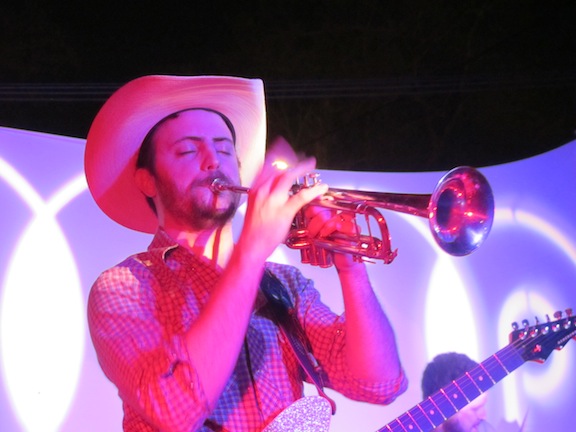
In what used to be an old, run-down Austin neighborhood a new group of cool bars has sprouted.  We started at Bar 96 where a great band called Crooks was playing.  I rapidly learned to love the live music of Austin. And I was surprised how much I liked the indie/country/bluegrass attitude that much of the music has.  Crooks was a great band.


But I immediately fell under the charm of Crooks' sexy banjo/mandolin/glitter guitar/trumpet player, Sam Alberts.


After Bar 96 we headed to Lustre Pearl, a dilapidated building that's been updated without losing the original character of the building.  I loved the neon above the living room fireplace.  It felt like a Glenn Ligon sculpture that somehow got lost in Austin by way of paris.  There was also a SXSW Interactive party going on so there were plenty of free tchotchkes from blinking glasses to glowing ice cubes.


Nearby is the Clive Bar which was the most boring of the three.  But it's still a beautiful place to hang out with friends and waste an hour or two.

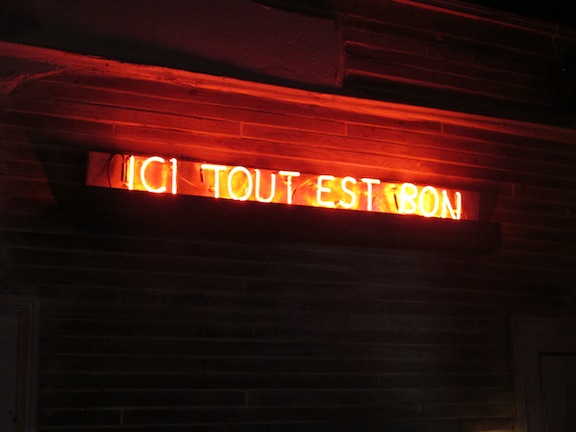
Of course, you can't just bar hop.  There comes a time when you need nourishment.  Fortunately, Austin offers a variety of all-night diners like Magnolia.  The food was standard diner fare, but the funky vibe was fantastic with it's neon, it's apology for being always open, and the intriguing collages on the walls.


We ended the night at The Ginger Man, a bar with 81 beers on tap.  That's enough to make me wish I liked beer.  But even if beer isn't your thing, this is one cool, beautiful place. And really, who doesn't like a ginger man?


I just barely scratched the surface of Austin nightlife.  So I guess I'll have to plan a return trip for another night on the town.

Food truck: Austin Edition.

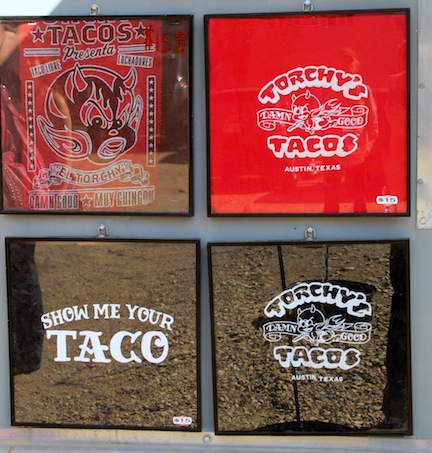
Sure, Vancouver has the Japadog. And we have the Chow Truck right here in Salt Lake City.  But I’ve never been to place with so many food trucks and trailers.  Maybe it’s the nice weather.  Maybe it’s the love of tacos. Or maybe it’s the penchant for all things funky.  Whatever it is, Austin loves it's food trucks. I only had time to visit two: the first and favorite was Torchy’s Tacos.  It was a bit of a jaunt to get to this trailer park turned outdoor food court.  But it was worth the trip. 


I had a fried avocado taco and something called the Trailer Park.


And how can you not love a place that sells t-shirts that read, “Show me your taco.”


We also went to a place called Turf n’ Surf Poboy where I was so hungry, I forgot to take pictures of my food. But here’s a photo of the truck.


Wednesday, March 16, 2011

Living in the Land of Raj.

Companies like to define target audiences with something called a "persona."  It’s a way to bring the target to life by giving him or her a personality.  One of my clients has a whole set of personas, one of which is for a target audience called technology enthusiasts.  These are the early adopters, the guys who are professional, successful, and who you might call geeks.  My clients have named this persona Raj.  And if you’re spending time at the South by Southwest (SXSW) interactive conference, you’re spending time with a lot of Rajes.

Here are a few of my key take aways from my time living in the Land of Raj with plenty of photos for support.

Raj likes his cool, intense, game-infused imagery.
And SXSW west gives plenty of people a chance to get their imagery out there.  Just about every pole, post, box, or other public space was wrapped in plastic to prepare for posters and flyers that were posted all over town, many of those poster targeted at Raj.


The QR code is king.  
These things were everywhere from posters, to trade show materials, to the backs of t-shirts.  Many technology enthusiasts were seen scanning away.


Celebrities that REALLY appeal to Raj may be completely unknown to me.
LIke the guy that started Foursquare, Dennis Crowley. (The first question from the Q&A: can a female friend of mine have a hug? The answer: yes.)  Here’s co-worker Kelly getting her picture taken with Dennis.


There was Felicia Day, a keynote speaker and star of  the heralded web series The Guild (huh?).  That’s one I’ve never heard of but the Technology Enthusiasts were falling all over themselves for this attractive geeky girl who “likes cupcakes.”  And I don’t think that’s some insider technology term.  Felicia is getting ready to launch an all new web series called Dragon Age: Redemption.  Here are the Ogilvy Notes from Felicia Day's presentation:


Also presenting a keynote address, Christopher Poole, the creator of a site called 4Chan.  Once again, I’d never heard of this place where anonymity reigns and anime is everywhere.  His new endeavor is a site called Canvas.  You can sign up for the service at canv.as/sxsw.

Raj likes his gadgets and right now, gadget = iPad.
At the pop-up Apple store set up just for SXSW, the iPad 2 sold out instantly.  And you could see people everywhere fiddling with their iPads, even sketching super-hero-like figures:


Finally, Raj may sometimes spend too much time tinkering with technology.
And not enough time getting out in the real world in hopes of meeting that special someone.  Well, at least now there's an APP for that:


Thanks Raj for making the SXSW Interactive Conference not just educational, but also a dang good time.

Monday, March 14, 2011

Country continental.

My second night in Austin found me at a classic Texas band bar, The Continental Club, to see Junior Brown.  I knew nothing of Junior Brown but on arrival, it seemed clear that Mr. Brown is an Austin legend and regular at The Continental Club.  Just inside the door was this painting of the club:


And if you notice the sign in the window, Junior Brown is the featured performer:


The Continental Club has been an Austin tradition since the late 50s and it's got the Texas dive-bar attitude to prove it, with walls and fixtures that are weathered in a way you can only accomplish with 60 or so years of drinking, dancing, and hard living.


While I knew nothing about Junior Brown, he delivered a perfect country rock soundtrack for a dark bar with lots of old red velvet.  Brown is an old-school guitar player and country crooner with original songs that run the gamut from country tragic to sublime goofiness.  With a rockabilly sensibility, Junior delivered a technically-brilliant, musically-dazzling night of torch and twang.  It seems I may like country a little more than previously imagined.  Here are a few more pictures from a night of country continental: