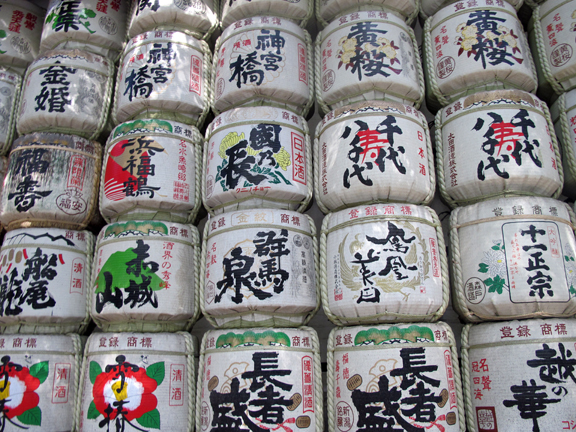
Kyoto's Gion district is a strange mashup of modern life and Japanese tradition. There's plenty of first-rate shopping including a series of covered streets that feature hundreds of shops, most populated by local vendors selling a variety of wares.
That's probably to be expected in a modern Japanese city. What isn't expected is the multitude of shrines that are peppered throughout the same area. One of our cab drivers informed us that there are more than 1,700 shrines in Kyoto. Every where you turn in the covered shopping streets you find little alleyways that lead you to shrines. And as you explore those alleyways, you find amazing nooks and crannies that seem completely out of place in a place that is all about capitalism. Somehow, it makes shopping more enjoyable. Here are some photos of the shrines I visited while enjoying a little Japanese shopping.
Tuesday, September 20, 2011
Biking Kyoto.
I learned long ago that your best friends in any foreign country are the hotel staff. Even if their English isn't perfect, they'll go out of their way to help you get where you want to go, or solve some other problem. At the Screen Hotel in Kyoto, the staff was particularly helpful. And their English was commendable. I stopped by the front desk to ask if a museum I wanted visit was within walking distance. The friendly staff said, "Yes, but why not take the bikes?" Exactly, why not takes the bikes!? That's the kind of helpful information that makes any hotel stay better.
So the next morning we hopped on the hotel's Japanese bikes with their big baskets and brilliant locking mechanisms and headed out for a day of museum visits and sight seeing. The verdict? If you're ever in Kyoto, absolutely, definitely, without question TAKE THE BIKES! Kyoto is the perfect biking city with few steep hills to climb and a population that happily tolerates bike riders. I hadn't had this much fun on a bicycle since I was a kid.
To commemorate the day, here are a couple of photos of Felix and me with our bikes:
And here is a video of us biking through Kyoto. Sorry for the shaky video but it was my flip camera on Japanese bicycle while trying not to kill myself:
So the next morning we hopped on the hotel's Japanese bikes with their big baskets and brilliant locking mechanisms and headed out for a day of museum visits and sight seeing. The verdict? If you're ever in Kyoto, absolutely, definitely, without question TAKE THE BIKES! Kyoto is the perfect biking city with few steep hills to climb and a population that happily tolerates bike riders. I hadn't had this much fun on a bicycle since I was a kid.
To commemorate the day, here are a couple of photos of Felix and me with our bikes:
And here is a video of us biking through Kyoto. Sorry for the shaky video but it was my flip camera on Japanese bicycle while trying not to kill myself:
Saturday, September 17, 2011
A shrine surprise.
My visit to the Harajuku district of Tokyo wasn't just about the craziness of Takeshita street. We did some official sight seeing as well with a stop to the famed Meiji Shrine. This grand structure was dedicated to Meiji Emperor and his consort Shoken. Here's the interesting part; it was completed in 1920. But destroyed in an air raid in 1945. World War II was hard on the landmarks of Japan. However I'm told the reconstructed structure is identical to the original.
This brings up an interesting observation about Japan. From war, to fire, to earthquakes, to tsunamis, Japan is a country that is constantly being destroyed. So there are very few structures that are more than a century old. That means that even though the country feels steeped in ancient traditions, the reality is that it's a country that lives in the now, constantly rebuilding. It's another example of the tension that is Japan: a desire to honor long-held tradition in a place where everything is new, or at least not old.
But that's not what we're here to discuss. We're here to talk about the Meiji Shrine. Here I am at the front gate. And what a front gate? I love these huge Japanese entrances.
The Meiji Shrine offers plenty of details to catch your attention, some subtle, some grand.
While we were in the main area of the shrine, a surprise procession entered with a fair bit of drama. I think it might have been a wedding as my guide book said that traditional, Shinto-style weddings are common.
Our visit was cut short (you can ask Felix about that), so we didn't get to explore much more. But even a brief visit to the Meiji Shrines gives you plenty of respect for the grandeur of Japan.
This brings up an interesting observation about Japan. From war, to fire, to earthquakes, to tsunamis, Japan is a country that is constantly being destroyed. So there are very few structures that are more than a century old. That means that even though the country feels steeped in ancient traditions, the reality is that it's a country that lives in the now, constantly rebuilding. It's another example of the tension that is Japan: a desire to honor long-held tradition in a place where everything is new, or at least not old.
But that's not what we're here to discuss. We're here to talk about the Meiji Shrine. Here I am at the front gate. And what a front gate? I love these huge Japanese entrances.
The Meiji Shrine offers plenty of details to catch your attention, some subtle, some grand.
While we were in the main area of the shrine, a surprise procession entered with a fair bit of drama. I think it might have been a wedding as my guide book said that traditional, Shinto-style weddings are common.
Our visit was cut short (you can ask Felix about that), so we didn't get to explore much more. But even a brief visit to the Meiji Shrines gives you plenty of respect for the grandeur of Japan.
Thursday, September 15, 2011
Yes Virginia, there really is an international museum of manga.
So I'm reading up on Kyoto and come across a listing for the Kyoto International Manga Museum. Exactly! How can you not pay a visit to anything named the Kyoto International Manga Museum? So we climbed on our bikes (more on that later), and peddaled our way to the museum.
I'll admit it, I'm not a big manga aficionado. And I didn't really know what to expect at this museum. It was different than I could have ever imagined. It's basically a repository for every Japanese manga book ever created since about 1940. There are stacks and stacks of manga books and you can browse to your heart's content. One floor features manga for young children. Another features manga for girls. And still another features manga for boys.
Of course, if you have trouble finding exactly what you're looking for, the museum staff is happy to help. One of the best museum cards I've ever seen is this:
Every where you went there were people pulling favorite manga books from the shelves and reading.
There were also exhibits that discussed the history of manga or even how it was made.
One of the funniest things about the museum is that is was crawling with television reporters. I've been watching crazy Japanese television since I arrived in the country. And for the first time, I got to see crazy Japanese television made. Here's a video:
I absolutely fell in love with the massive bank of manga vending machines.
I bought a few things from the vending machines. And a few things from the gift shop. Most of which may be headed for my favorite manga fans, my nieces.
I loved the Kyoto International Manga Museum and if I'm ever in the area again, I'll be sure to retun.
I'll admit it, I'm not a big manga aficionado. And I didn't really know what to expect at this museum. It was different than I could have ever imagined. It's basically a repository for every Japanese manga book ever created since about 1940. There are stacks and stacks of manga books and you can browse to your heart's content. One floor features manga for young children. Another features manga for girls. And still another features manga for boys.
Of course, if you have trouble finding exactly what you're looking for, the museum staff is happy to help. One of the best museum cards I've ever seen is this:
Every where you went there were people pulling favorite manga books from the shelves and reading.
There were also exhibits that discussed the history of manga or even how it was made.
One of the funniest things about the museum is that is was crawling with television reporters. I've been watching crazy Japanese television since I arrived in the country. And for the first time, I got to see crazy Japanese television made. Here's a video:
I absolutely fell in love with the massive bank of manga vending machines.
I bought a few things from the vending machines. And a few things from the gift shop. Most of which may be headed for my favorite manga fans, my nieces.
I loved the Kyoto International Manga Museum and if I'm ever in the area again, I'll be sure to retun.
This is REAL hotel service: Luggage transfer.
The staff and porters at the Yuzuya ryokan were unbelievably attentive. And one of the services they offered was luggage transfer. For a reasonable fee, they would handle transferring all your luggage from Yuzuya to our next hotel, The Screen. My response, "sign me up." Rather than lug our luggage to the hotel, have them hold it for us until check in time, we went sight seeing. And then late in the afternoon we checked in at The Screen where our luggage was waiting in our room, each piece carefully tagged by the Yuzuya staff and addressed personally to Mr. Jeffrey.
Heads up friends back home: I've decided that from here on out, I might want to be referred to as Mr. Jeffrey.
Japanese breakfast: English for weird food.
When we checked into the Yuzuya ryokan, they carefully scheduled our dinner and then asked if we wanted the Japanese or continental breakfast. We chose Japanese to get the full ryokan experience. Here's the translation of that request.
The first plate was this:
On the right is a bowl of rice covered with a sticky, gooey substance called grated taro. With your rice you could enjoy all kinds of little samplings. I'll try and remember what they were starting in the upper left and working my way across and down the grid. First was baby eel with chopped peppers. After the previous night's eel, I was terrified to taste this dish. But I actually liked it.
Next was a bowl of tiny shell fish in a salty sauce. It was delicious. Then there was a sweet potato that was delicious. Next bowl, I don't remember what it was but there were pickles and I like the Japanese pickles.
Next was shaved soba and some sort of vegetable. It was pretty good. Then there was "deep-fried" tofu. I don't know how they deep fry things in Japan but it's completely different that they way we do it in the US. Once again, "deep fried" meant soggy.
The bottom row starts with pickled tiny cucumbers. I could eat these all day. Then came sea weed; I didn't like this. Finally, something else pickled. Did I already say this, I love Japanese pickles.
Here's the second plate:
This plate featured a grilled fish (I can't remember exactly what type). Then in the top bowl was an eggplant dish that I didn't like at all. It was totally slimy. Lower left is "rolled egg" with grated radish on top. I liked this a lot although it's strange how differently eggs can be cooked. The final dish was miso soup. Can I just say, miso soup is so much better in Japan than it is in the US. I normally hate it, but here it is consistently good.
A big thanks to the Yuzuya staff for creating a memorable meal. Just as memorable as the entire stay.
The first plate was this:
On the right is a bowl of rice covered with a sticky, gooey substance called grated taro. With your rice you could enjoy all kinds of little samplings. I'll try and remember what they were starting in the upper left and working my way across and down the grid. First was baby eel with chopped peppers. After the previous night's eel, I was terrified to taste this dish. But I actually liked it.
Next was a bowl of tiny shell fish in a salty sauce. It was delicious. Then there was a sweet potato that was delicious. Next bowl, I don't remember what it was but there were pickles and I like the Japanese pickles.
Next was shaved soba and some sort of vegetable. It was pretty good. Then there was "deep-fried" tofu. I don't know how they deep fry things in Japan but it's completely different that they way we do it in the US. Once again, "deep fried" meant soggy.
The bottom row starts with pickled tiny cucumbers. I could eat these all day. Then came sea weed; I didn't like this. Finally, something else pickled. Did I already say this, I love Japanese pickles.
Here's the second plate:
This plate featured a grilled fish (I can't remember exactly what type). Then in the top bowl was an eggplant dish that I didn't like at all. It was totally slimy. Lower left is "rolled egg" with grated radish on top. I liked this a lot although it's strange how differently eggs can be cooked. The final dish was miso soup. Can I just say, miso soup is so much better in Japan than it is in the US. I normally hate it, but here it is consistently good.
A big thanks to the Yuzuya staff for creating a memorable meal. Just as memorable as the entire stay.
The magic of the endlessly expanding, Japanese coinage.
OK, what's with the Japanese coins? Once they start collecting in your pockets they refuse to stop. In fact, they multiply at an alarming rate. And believe me, I'm trying to get rid of them. Just moments ago at the Family Mart I was so proud to use four coins to pay for my purchase. And then, in return, I received seven coins.
Yesterday, I used what I thought was exact change for a subway ticket and received a handful of coins in return. I have my suspicions. I think the Japanese are playing a joke on us gaijin, secretly laughing at us as they load our pockets with massive amounts of coins, many of which are largely worthless; watching us trudge with evermore difficulty through the heat and humidity, burdened by our coinage; wondering when we'll figure out the mathematics of Japanese change; hoping that we won't catch on too soon.
Well I'm not giving up. I'll still keep paying with coins. Sooner or later, I intend to solve the mystery of the coin-purse bulge.
Yesterday, I used what I thought was exact change for a subway ticket and received a handful of coins in return. I have my suspicions. I think the Japanese are playing a joke on us gaijin, secretly laughing at us as they load our pockets with massive amounts of coins, many of which are largely worthless; watching us trudge with evermore difficulty through the heat and humidity, burdened by our coinage; wondering when we'll figure out the mathematics of Japanese change; hoping that we won't catch on too soon.
Well I'm not giving up. I'll still keep paying with coins. Sooner or later, I intend to solve the mystery of the coin-purse bulge.
Subscribe to:
Posts (Atom)